| HOME | COLLECTIONS | EXHIBITIONS | LITERATURE | BOOKS & PUBLICATIONS | PROJECTS | WORKS OF ART |
In 1970, en route to Ireland to look for somewhere suitable to settle, herman de vries visited by chance the agricultural hamlet of Eschenau in northern Bavaria, close to the edge of the great forest of the Steigerwald. Eschenau is an unremarkable place: a handsome church stands on a knoll overlooking the village, which measures the hours by its bell, and there is a small and comfortable family inn, with a number of farmhouses centred around it. The beer it serves is no longer brewed in the village, though traces of the hops that once flavoured it can be found living wild on such local trees and hedges as have been spared the chain saws and mechanical diggers of modern agriculture. Like the other small towns and villages of the region, Eschenau is quiet, neat and, perhaps, too well-kept. It is certainly not picturesque. Unless you had business here it is unlikely that you would stop the car. Its inhabitants are, by and large, devout and hard-working farmers, traditional in their social values, discreet and respectable.![]() | In this landscape, his studio, and at the edge of the forest, lies one of his most important works: die wiese, a meadow of about 4,000 m², which is tended by the artist. |
![]() | In 2006 de vries has created spuren in the woods and quarries around Eschenau, thus making an invisible bond between the spirit of his home landscape and Digne-les-Bains, in Haute Provence. |
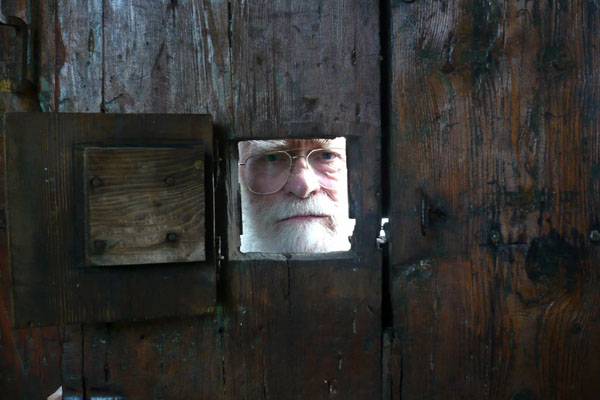
![]() | During a stay in Eschenau in April 2012, publisher and designer Peter Foolen took a number of photographs. A selection of these photographs are available on this website.
© Peter Foolen, Eindhoven. |
Click on the image to start the slideshow! | |